ELL 1000: Introduction to Electrical Engineering
66 questions across 7 topics · 10 tests. Every test covers every topic, and each student gets a different topic-balanced draw.
Basic Concepts
8 QCharge, current, voltage, energy and power.
Question
Ampere second could be the unit of:
Correct answer: Charge
Question
A utility company charges 8.2 cents/kWh. If a consumer operates a 60-W light bulb continuously for one day, how much is the consumer charged?
Correct answer: 11.8 cents
Question
If moving 16 C of charge from point b to point a requires 0.8 J. Vab the voltage drop from point a to b would be:
Correct answer: 0.05 V
Question
The conventional direction of electric current flow is:
Correct answer: opposite to the direction of flow of electrons.
Question
An automobile battery is charged with a constant current of 2A for five hours. The terminal voltage of the battery is v = 11+ 0.5t V for t > 0, where t is in hours. The energy delivered to the battery in watt-hour during the five hours is:
Correct answer: 122.5 wh
Question
Determine the total charge transferred over the time interval of 0 ≤ t ≤ 10 s when i (t) = ½ t A.
Correct answer: 25 C
Question
Find the charge that has entered the terminal of an element from t = 0 s to t = 3 s when the current entering the element is as shown in Figure 1.
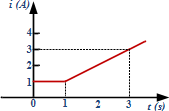
Correct answer: 5 C
Question
How many joules does a 60 W light bulb consume in 1-hour?
Correct answer: 216 kJ
Circuit Elements & Devices
8 QResistors, inductors, capacitors and diodes.
Question
If a constant current is passing through an inductor, the voltage across the inductor would be :
Correct answer: zero
Question
The energy stored by inductor is proportional to:
Correct answer: square of the current through it
Question
The average power consumed by a capacitor in one cycle of periodic AC signal is:
Correct answer: zero
Question
Find the equivalent inductance of the circuit of Figure 2.
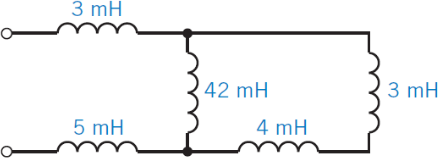
Correct answer: 14 mH
Question
Determine the voltage across an inductor v(t) when the inductance is L = 250 mH, and the current is i(t)= 120 sin (500t – 30o) mA.
Correct answer: 15 sin (500t + 60o) V
Question
Find the equivalent capacitance for the circuit in Figure 3.
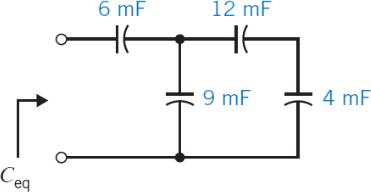
Correct answer: 4 mF
Question
The voltage across a 40 µF capacitor is 25 V at t0 = 0. If the current through the capacitor as a function of time is given by i(t) = 6e-6t mA for t > 0, find v(t) for t > 0.
Correct answer: 50 - 25e-6t V
Question
In forward biased condition, Diode becomes ON once applied voltage level crosses:
Correct answer: knee voltage
Kirchhoff's Laws & Network Graph
8 QKCL, KVL, nodes, branches, loops and meshes.
Question
A network has 12 branches and 8 independent loops. How many nodes are there in the network?
Correct answer: 5
Question
KCL is based on the fact that:
Correct answer: There cannot be an accumulation of charge at a node.
Question
Kirchhoff’s laws are valid for?
Correct answer: both linear and non-linear circuits.
Question
Relation between currents in Figure 8, According to KCL is:
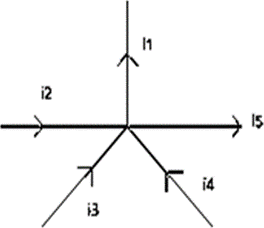
Correct answer: i1+i5=i2+i3+i4
Question
All _____________ are loops but all _______________ are not meshes.
Correct answer: Meshes, loops
Question
Kirchhoff’s current law at a junction is based on:
Correct answer: conservation of charge
Question
If there are 10 nodes in a circuit, how many equations do we get in nodal analysis?
Correct answer: 9
Question
Kirchhoff’s voltage law in a closed path is based on:
Correct answer: conservation of energy
Nodal Analysis
9 QNode voltages, supernodes and reference nodes.
Question
Find Vx for the circuit shown in Figure 5.
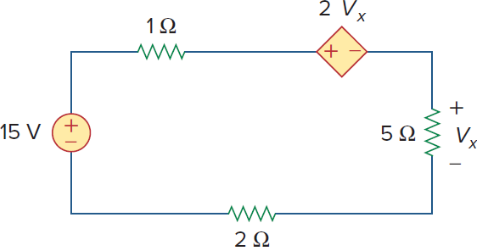
Correct answer: 4.16 V
Question
The current Io in Figure 9 is:
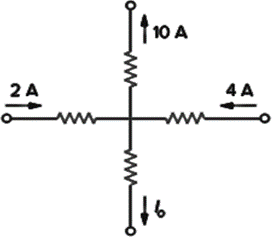
Correct answer: -4 A
Question
Find the value of the node voltage v in Figure 10.
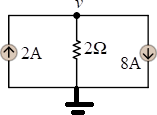
Correct answer: -12V
Question
Calculate VA-VB for the circuit shown in Figure 11.

Correct answer: 10 V
Question
Find the value of the node voltage v in Figure 16.
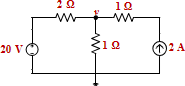
Correct answer: 8 V
Question
In the circuit of Figure 17, the voltage v2 is
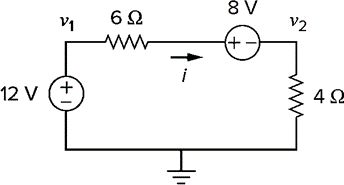
Correct answer: 1.6 V
Question
In nodal analysis supernode in a circuit is formed when:
Correct answer: a voltage source appears between two non-reference node
Question
Which of the following statement is wrong? In node-voltage technique of solving networks, choice of reference node does not
Correct answer: affect the voltages of various nodes.
Question
Nodal analysis can be applied for________
Correct answer: Both planar and non-planar networks
Resistive Networks & Star–Delta
10 QSeries/parallel, source transformation and Y–Δ conversion.
Question
Determine io for the circuit shown in Figure 4.
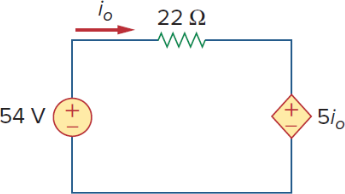
Correct answer: 2 A
Question
A voltage source of 20 V in series with a resistance of 4 Ω can be converted into a current source and a parallel resistance with values:
Correct answer: 5 A and 4 Ω
Question
The star network is made of equal resistances of value R, then magnitude of each resistance of its equivalent delta circuit is:
Correct answer: 3R
Question
Ra is resistance at A, Rb is resistance at B, Rc is resistance at C in star connection. After transforming to delta, what is resistance between B and C?
Correct answer: Rc+Rb+(Rc*Rb/Ra)
Question
In given Figure 6, Ra, Rb and Rc are 20, 10 and 10 ohms, the values of R1, R2 and R3 are?
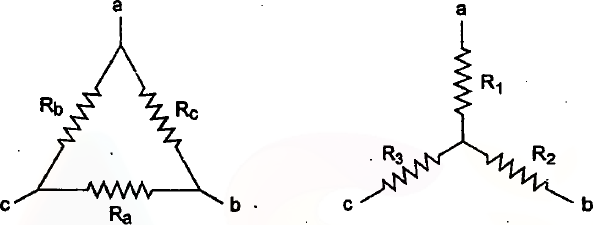
Correct answer: 2.5 ohms,5 ohms and 5 ohms
Question
The resistance between A and B with C open is 12 ohms (Refer Figure 7). Resistance between B and C with A open is 22 ohms. The resistance between C and A with B open is 18 ohms. The values of RA, RB and RC are?
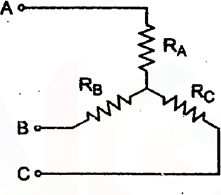
Correct answer: 4 ohms ,8 ohms and 14 ohms
Question
In the circuit of Figure 12 , power delivered by 24 V source is:
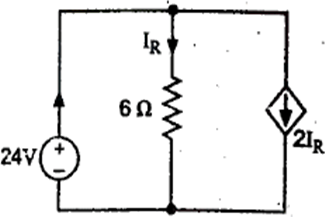
Correct answer: 288 W
Question
All resistances are of 2 ohms (Refer Figure 13). What happens to light intensity when switch is closed?
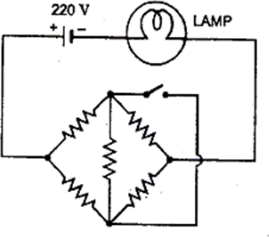
Correct answer: Remains same
Question
The value of current I in Figure 14 is:
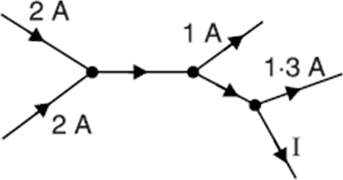
Correct answer: 1.7 A
Question
For the circuit shown in the Figure 25 the current I is :
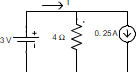
Correct answer: 1 A
Network Theorems
13 QThévenin, Norton, superposition and maximum power transfer.
Question
The power delivered by 6V source in Figure 18 is:
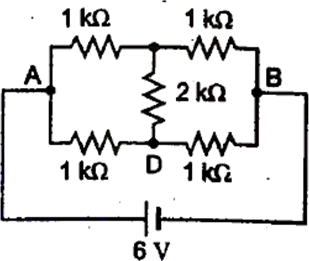
Correct answer: 36 mW
Question
Determine the power supplied by 3 V voltage source in the circuit of Figure 19.
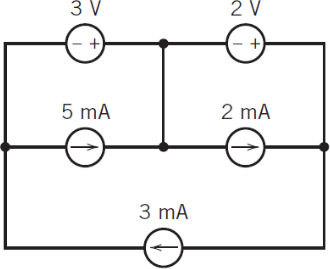
Correct answer: -6 mW
Question
The Thevenin resistance is found by:
Correct answer: Shorting all voltage sources and opening all current sources
Question
The Thevenin theorem is true for:
Correct answer: Linear networks
Question
Application of Norton's theorem to a circuit yield
Correct answer: Equivalent current source and impedance in parallel
Question
The Norton resistance RN is exactly __________ as that of the Thevenin resistance RTh.
Correct answer: Same
Question
Thevenin’s resistance across terminal ab for the circuit shown in Figure 22 is:
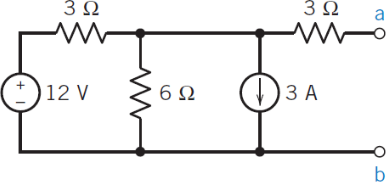
Correct answer: 5 Ω
Question
Thevenin’s voltage across terminal ab for the circuit shown in Figure 22 is:
Correct answer: 2 V
Question
Find the Thevenin equivalent voltage for the circuit shown in Figure 23.
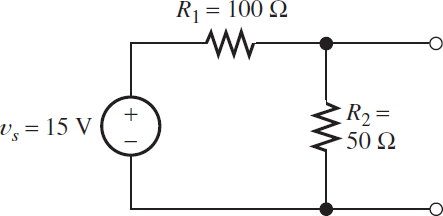
Correct answer: 5 V
Question
Find the Norton current for the circuit shown in Figure 24.
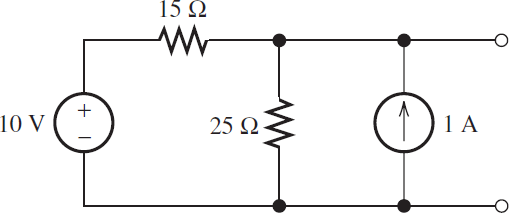
Correct answer: 1.67 A
Question
The superposition theorem is applicable to:
Correct answer: Both current and voltage
Question
A load is connected to a network. At the terminals to which the load is connected, RTh = 10 Ω and VTh = 40 V. The maximum possible power supplied to the load is:
Correct answer: 40 W
Question
Efficiency of power transfer when maximum transfer of power occur is:
Correct answer: 50%
Transient Analysis
10 QFirst-order RC/RL circuits and time constants.
Question
An RC circuit has R = 2 Ω and C = 4 F. The time constant is:
Correct answer: 8 s
Question
The time constant for an RL circuit with R = 2 Ω and L = 4 H is:
Correct answer: 2 s
Question
A capacitor in an RC circuit with R = 2 Ω and C = 4 F is being charged. The time required for the capacitor voltage to reach 63.2 percent of its steady state value is:
Correct answer: 8 s
Question
An RL circuit has R = 2 Ω and L = 4 H. The time needed for the inductor current to reach 40 percent of its steady-state value is:
Correct answer: 1 s
Question
Determine the time constant for the circuit in Figure 26.
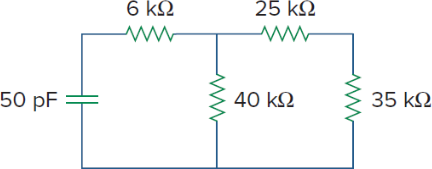
Correct answer: 1.5 µs
Question
The variable resistor R in Figure 27 is adjusted until it absorbs the maximum power from the circuit the value of R for maximum power ……….. Ω
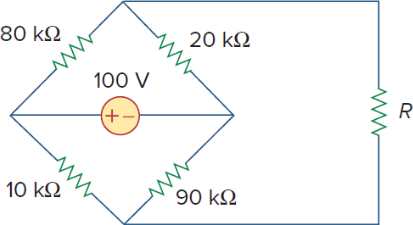
Correct answer: 25 kΩ
Question
In the circuit of Figure 28, the capacitor voltage just before t = 0 is:
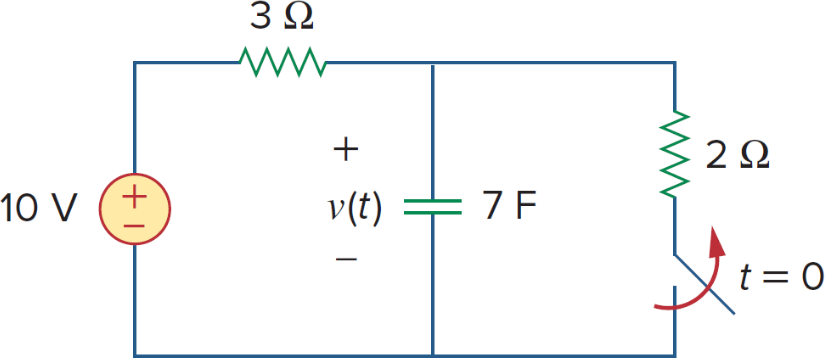
Correct answer: 4 V
Question
Consider the circuit given in Figure 29, Find steady state of i(t) if v(t) = 20 V.
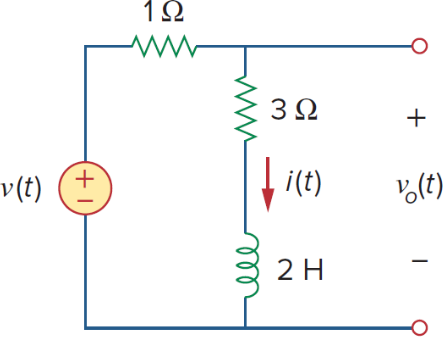
Correct answer: 5 A
Question
Find the time constant of the circuit shown in Figure 30.
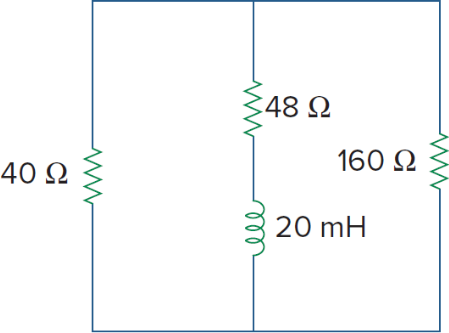
Correct answer: 250 µs
Question
An RC circuit is an example of :
Correct answer: First order circuit